Arabic in the Languages of Muslim Peoples
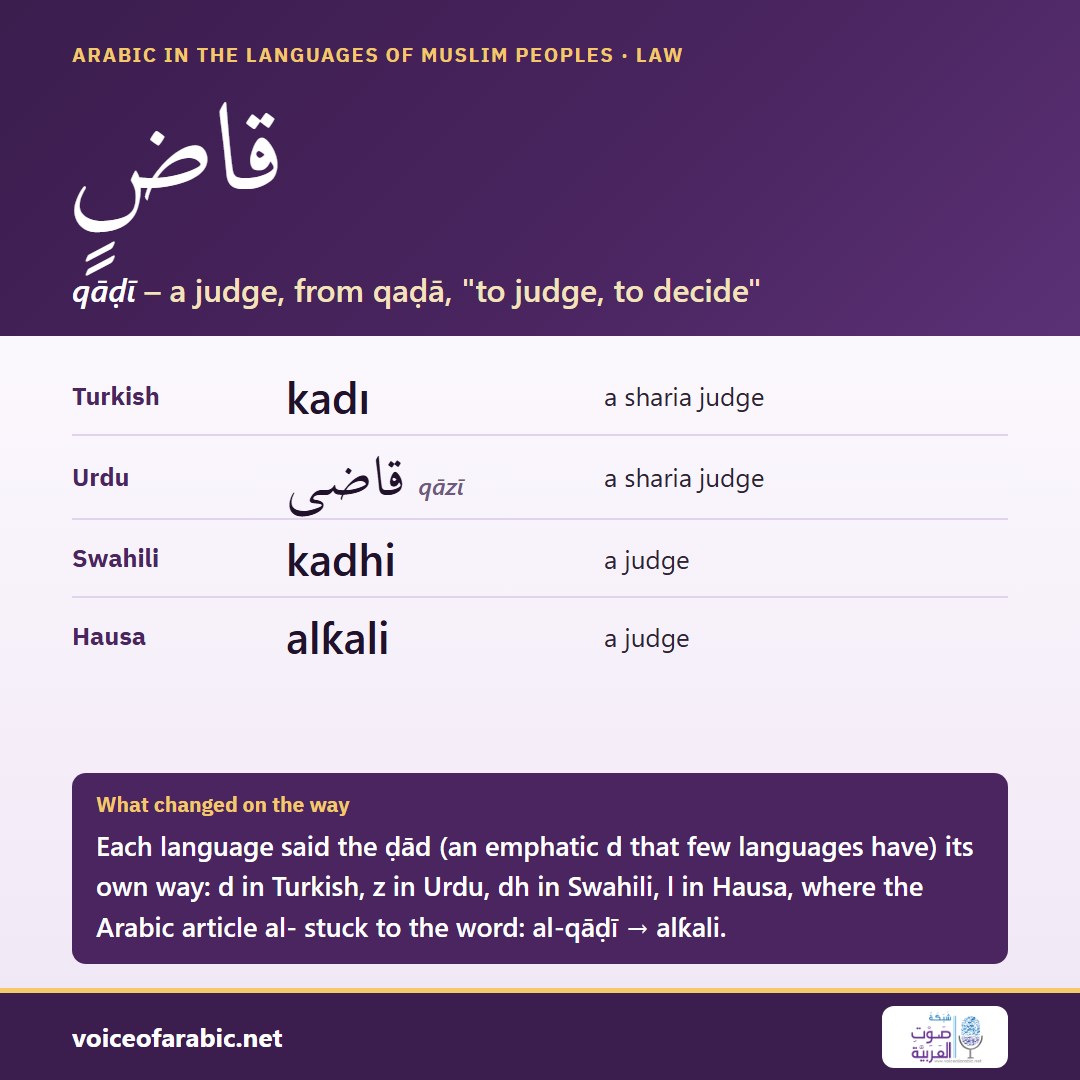
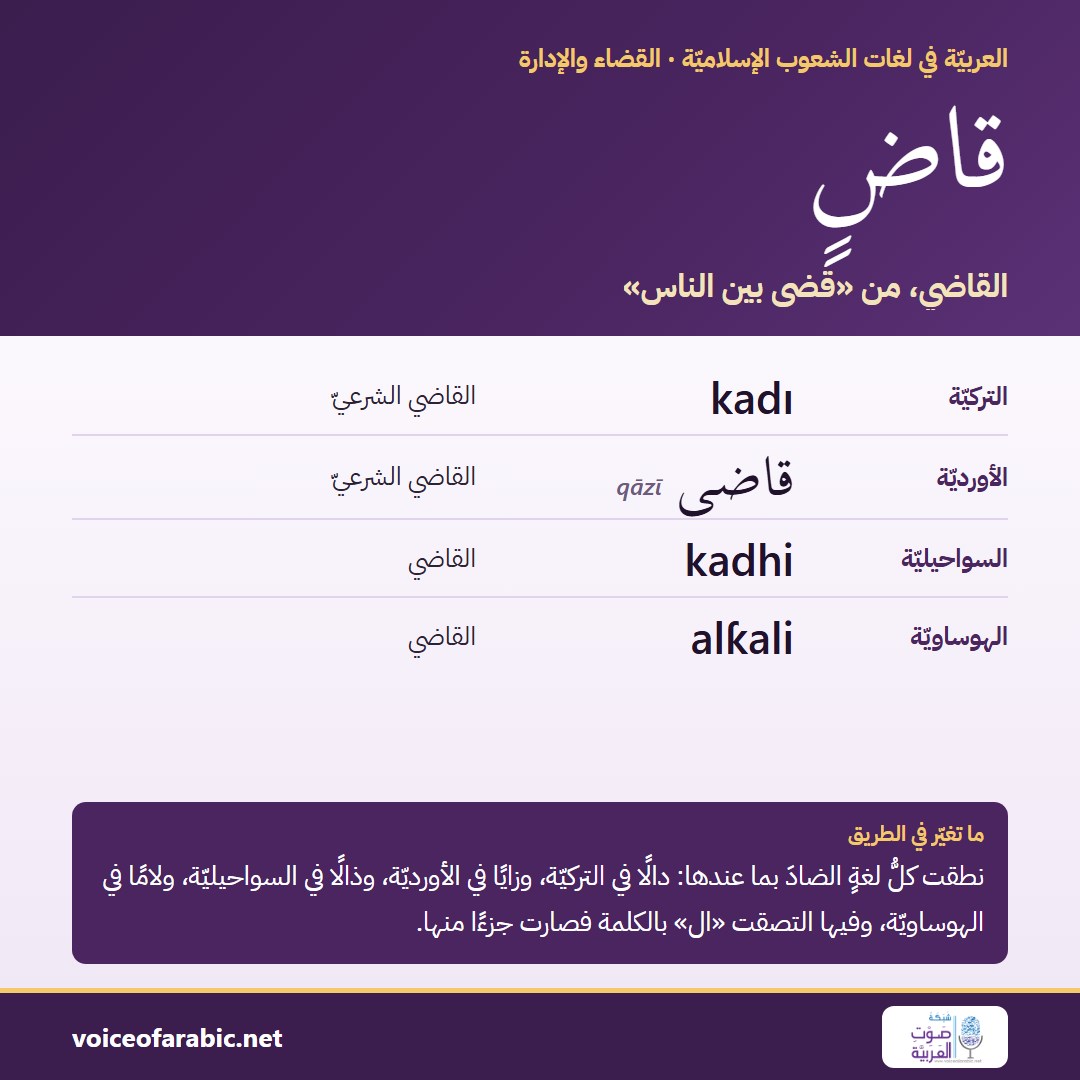
قاضٍ
a judge, from qaḍā, "to judge, to decide"
qāḍī
- Field
- Law and administration
The word in other languages
Each form in its own language's script, with its sources. Anything marked "single source" has only one source we could find, so it is shown on this page only, not on the card.
-
Turkish kadı on the card
a sharia judge
Sources: Nişanyan, Turkish etymological dictionary (via etimolojiturkce.com); Wiktionary (English edition)
-
Persian قاضی qâzi
a judge
Sources: Steingass, A Comprehensive Persian-English Dictionary (1892), University of Chicago edition; Wiktionary (English edition)
-
Urdu قاضی qāzī on the card
a sharia judge
Sources: Platts, A Dictionary of Urdu, Classical Hindi and English (1884), University of Chicago edition; Wiktionary (English edition)
-
Urdu جونپور کا قاضی jaunpur kā qāzī single source
"the qazi of Jaunpur": said of a fool
Sources: Platts, A Dictionary of Urdu, Classical Hindi and English (1884), University of Chicago edition
-
Indonesian kadi
a judge of Islamic religious cases
Sources: KBBI, the official Great Dictionary of the Indonesian Language; Wiktionary (English edition)
-
Malay kadi in Jawi script: قاضي single source
a sharia judge
Sources: Kamus Dewan, 4th edition, on the PRPM portal of Dewan Bahasa dan Pustaka, Malaysia
-
Swahili kadhi on the card
a judge
Sources: Madan, Swahili-English Dictionary (Oxford, 1903); Rechenbach, Swahili-English Dictionary (Catholic University of America, 1967); Wiktionary (English edition)
-
Hausa alƙali on the card
a judge
Sources: Bargery, A Hausa-English Dictionary (1934), online edition; Robinson, Dictionary of the Hausa Language (Cambridge, 1913); Wiktionary (English edition)
-
Hausa alƙali single source
also the pointer of a balance, as if it judged between the pans
Sources: Bargery, A Hausa-English Dictionary (1934), online edition
-
Bosnian kadija
a sharia judge, borrowed through Turkish
Sources: Abdulah Škaljić, Turcizmi u srpskohrvatskom jeziku (Sarajevo, 1966); Wiktionary (English edition)
Persian also says z (qâzi), and Indonesian and Malay say d (kadi).
Click a card to see it full size; each has a download button for sharing.
Sources
- Nişanyan, Turkish etymological dictionary (via etimolojiturkce.com): kadı
- Wiktionary (English edition): kadı (Turkish)
- Steingass, A Comprehensive Persian-English Dictionary (1892), University of Chicago edition: قاضى
- Wiktionary (English edition): قاضی (Persian)
- Platts, A Dictionary of Urdu, Classical Hindi and English (1884), University of Chicago edition: قاضی
- Wiktionary (English edition): قاضی (Urdu)
- KBBI, the official Great Dictionary of the Indonesian Language: kadi
- Wiktionary (English edition): kadi (Indonesian)
- Kamus Dewan, 4th edition, on the PRPM portal of Dewan Bahasa dan Pustaka, Malaysia: kadi
- Madan, Swahili-English Dictionary (Oxford, 1903): Kathi
- Rechenbach, Swahili-English Dictionary (Catholic University of America, 1967): kadhi
- Wiktionary (English edition): kadhi (Swahili)
- Bargery, A Hausa-English Dictionary (1934), online edition: alkali
- Robinson, Dictionary of the Hausa Language (Cambridge, 1913): alkali
- Wiktionary (English edition): alƙali (Hausa)
- Abdulah Škaljić, Turcizmi u srpskohrvatskom jeziku (Sarajevo, 1966): kadija
- Wiktionary (English edition): kadija (Serbo-Croatian)
Spotted a mistake, or have something to add?
Your note comes to us only; it is not published here. We read it, and if it holds we correct the card.