Arabic in the Languages of Muslim Peoples
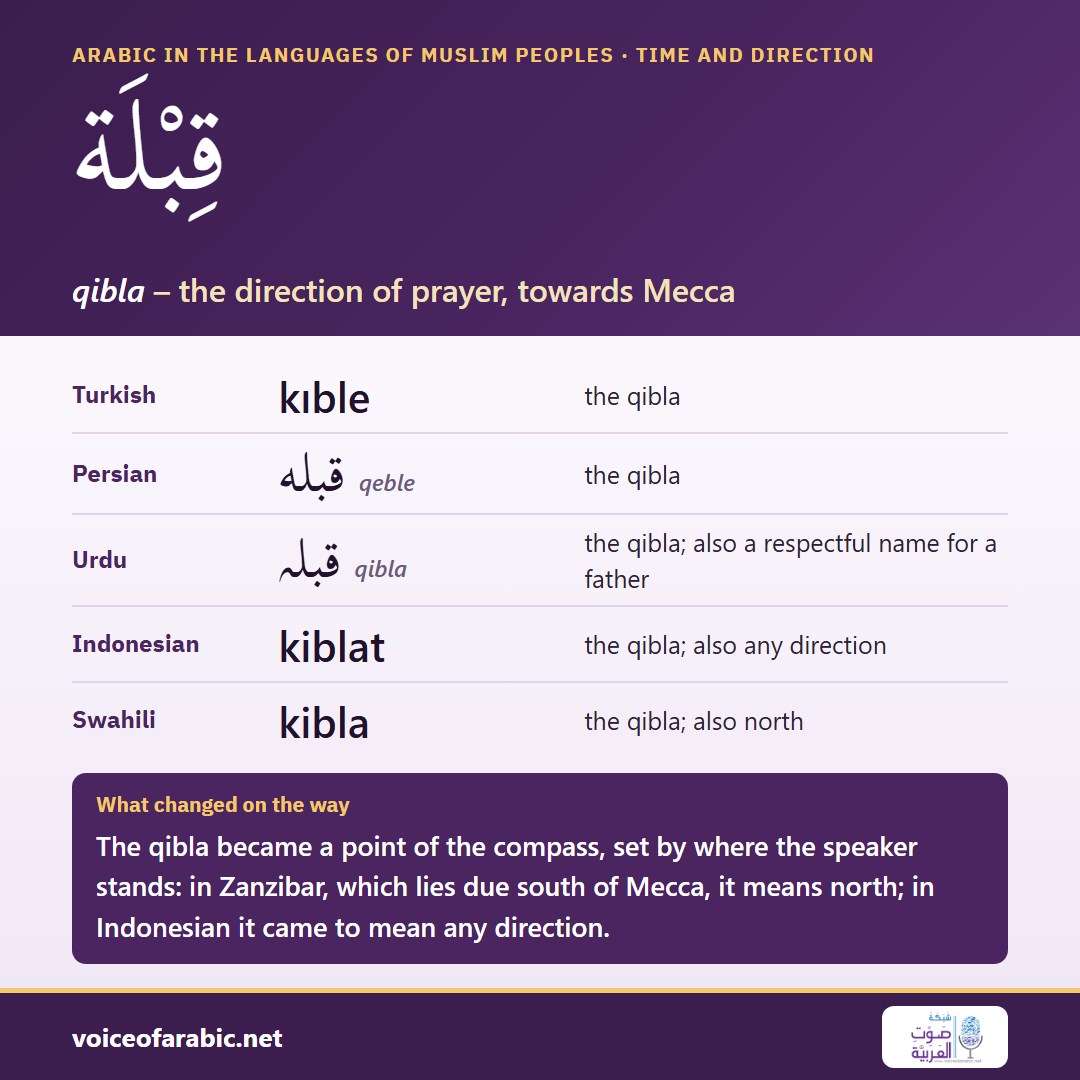
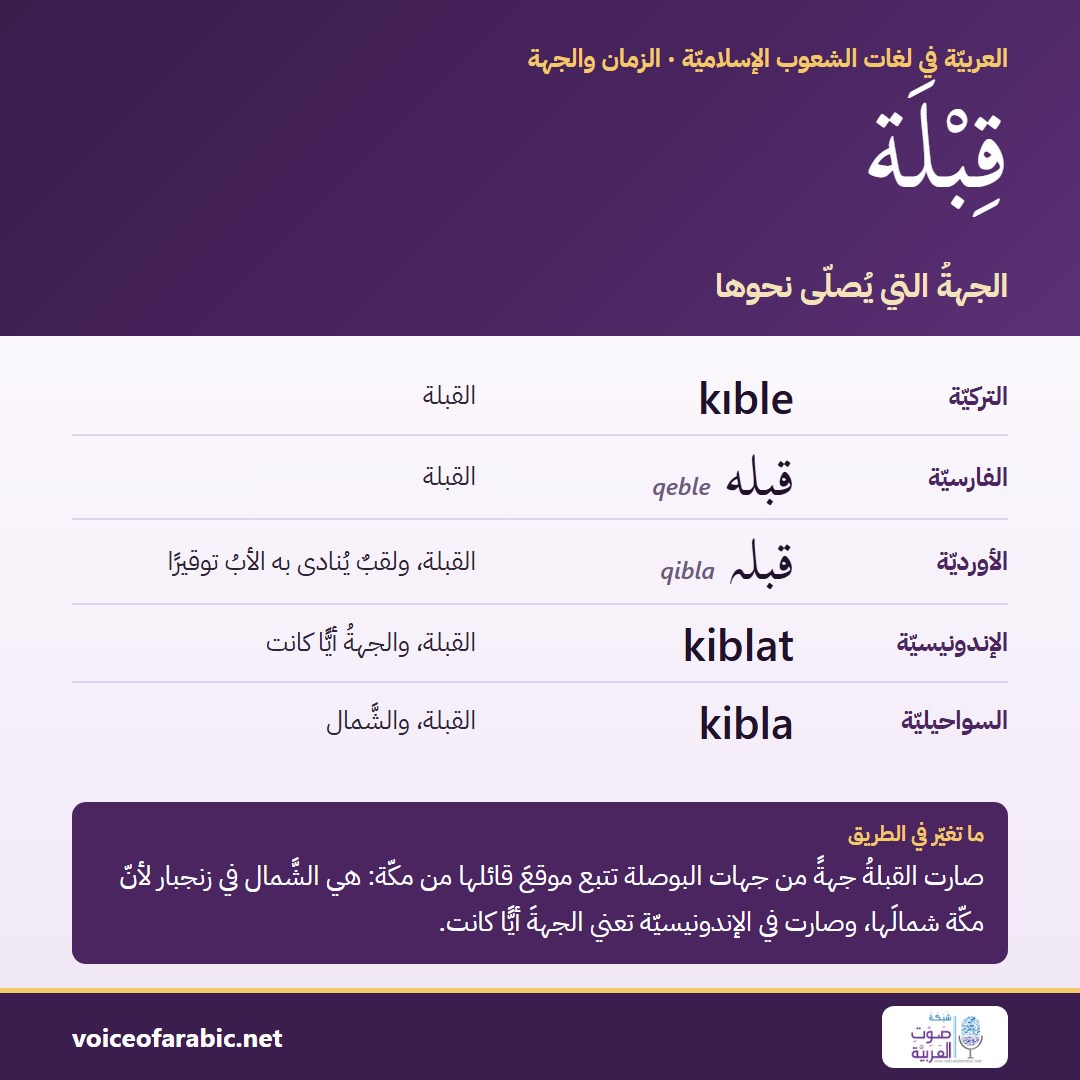
قِبْلَة
the direction of prayer, towards Mecca
qibla
- Field
- Time and direction
«والقِبْلة التي يُصَلَّى نحوها… والقِبْلة في الأصل الجهة»
The word in other languages
Each form in its own language's script, with its sources. Anything marked "single source" has only one source we could find, so it is shown on this page only, not on the card.
-
Turkish kıble on the card
the qibla
Sources: Nişanyan, Turkish etymological dictionary (via etimolojiturkce.com); Wiktionary (English edition)
-
Turkish kıble single source
in a record from 1533: a light wind from the south-east
Sources: Nişanyan, Turkish etymological dictionary (via etimolojiturkce.com)
-
Persian قبله qeble on the card
the qibla
Sources: Steingass, A Comprehensive Persian-English Dictionary (1892), University of Chicago edition; Wiktionary (English edition)
-
Urdu قبلہ qibla on the card
the qibla; also a respectful way to address one's father: "Qibla!"
Sources: Platts, A Dictionary of Urdu, Classical Hindi and English (1884), University of Chicago edition; Wiktionary (English edition)
-
Indonesian kiblat on the card
the qibla; also a direction, a point of the compass
Sources: KBBI, the official Great Dictionary of the Indonesian Language; Wiktionary (English edition)
-
Malay kiblat in Jawi script: قبلة
the qibla; also a direction: east, west and so on; the source of the Indonesian word
Sources: Kamus Dewan, 4th edition, on the PRPM portal of Dewan Bahasa dan Pustaka, Malaysia; Wiktionary (English edition)
-
Swahili kibla on the card
the qibla; the mihrab of a mosque; north (in Zanzibar)
Sources: Madan, Swahili-English Dictionary (Oxford, 1903); Rechenbach, Swahili-English Dictionary (Catholic University of America, 1967); Wiktionary (English edition)
-
Bosnian kibla
the qibla
Sources: Abdulah Škaljić, Turcizmi u srpskohrvatskom jeziku (Sarajevo, 1966); Wiktionary (English edition)
-
Bosnian kibla single source
and for Bosnians the qibla is the south-east: "Kod nas je kibla jugoistok", "with us the qibla is south-east"
Sources: Abdulah Škaljić, Turcizmi u srpskohrvatskom jeziku (Sarajevo, 1966)
The final tāʾ marbūṭa of qibla (the -a ending that Arabic writes with a closed t) surfaces as -t in Indonesian and Malay: kiblat.
The Hausa form alƙibla is left out, as we could not find two sources for it.
Click a card to see it full size; each has a download button for sharing.
Sources
- Ibn Manzur, Lisan al-Arab, vol. 11, p. 545
- Nişanyan, Turkish etymological dictionary (via etimolojiturkce.com): kıble
- Wiktionary (English edition): kıble (Turkish)
- Steingass, A Comprehensive Persian-English Dictionary (1892), University of Chicago edition: قبلة
- Wiktionary (English edition): قبله (Persian)
- Platts, A Dictionary of Urdu, Classical Hindi and English (1884), University of Chicago edition: قبله
- Wiktionary (English edition): قبلہ (Urdu)
- KBBI, the official Great Dictionary of the Indonesian Language: kiblat
- Wiktionary (English edition): kiblat (Indonesian)
- Kamus Dewan, 4th edition, on the PRPM portal of Dewan Bahasa dan Pustaka, Malaysia: kiblat
- Madan, Swahili-English Dictionary (Oxford, 1903): Kibla
- Rechenbach, Swahili-English Dictionary (Catholic University of America, 1967): kibla
- Wiktionary (English edition): kibla (Swahili)
- Abdulah Škaljić, Turcizmi u srpskohrvatskom jeziku (Sarajevo, 1966): kibla
- Wiktionary (English edition): kibla (Serbo-Croatian)
Spotted a mistake, or have something to add?
Your note comes to us only; it is not published here. We read it, and if it holds we correct the card.