What others said about Arabic Read in the original
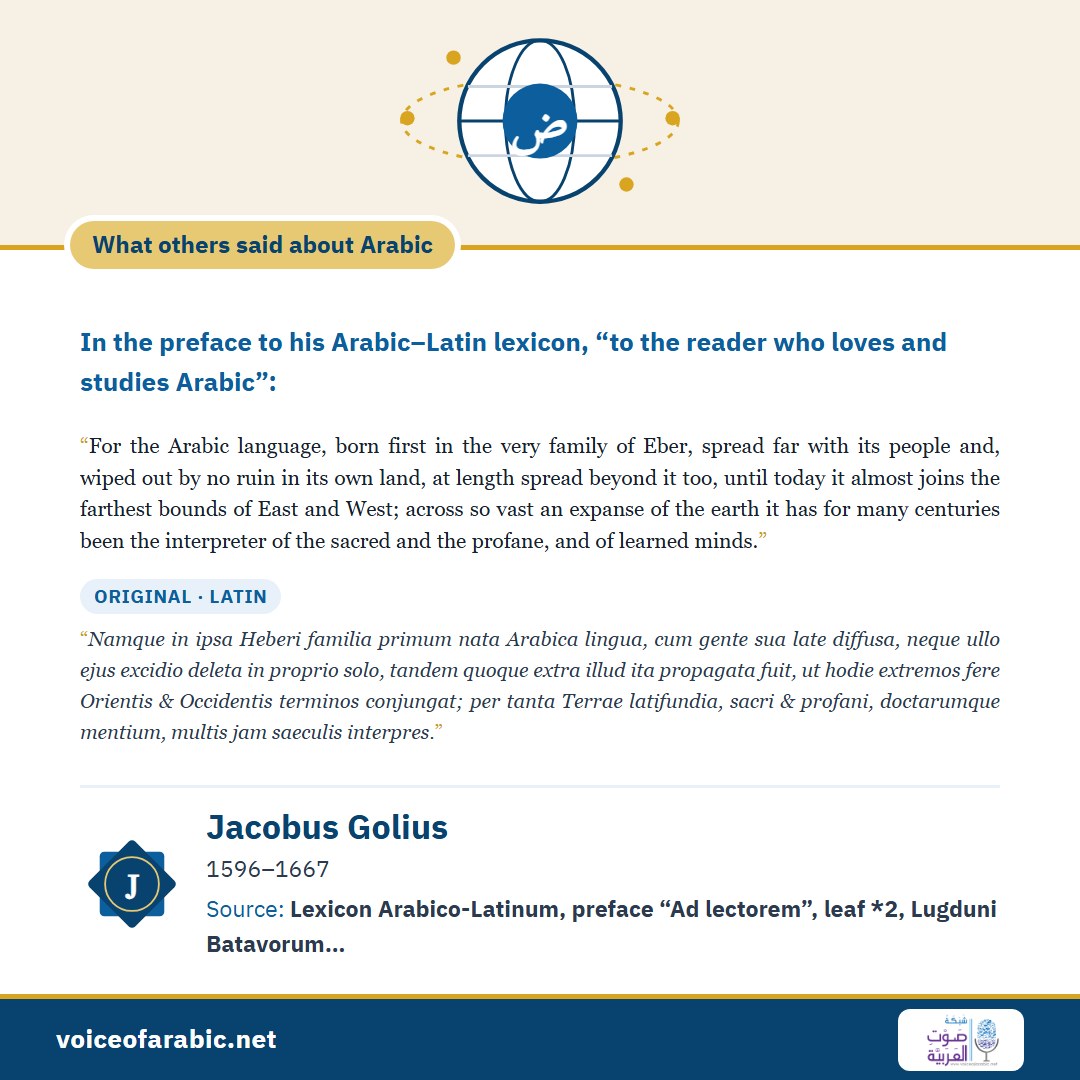
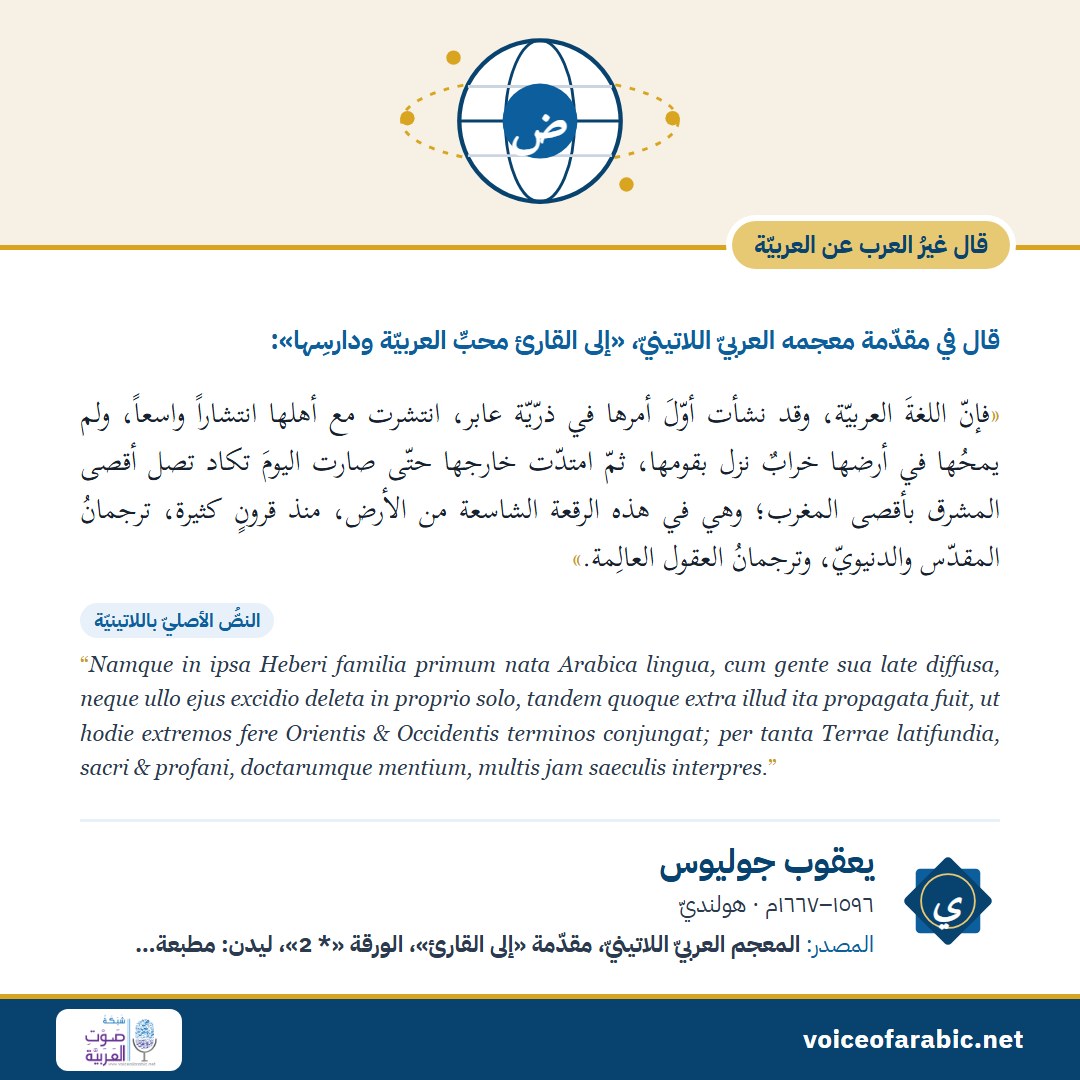
In the preface to his Arabic–Latin lexicon, “to the reader who loves and studies Arabic”:
“For the Arabic language, born first in the very family of Eber, spread far with its people and, wiped out by no ruin in its own land, at length spread beyond it too, until today it almost joins the farthest bounds of East and West; across so vast an expanse of the earth it has for many centuries been the interpreter of the sacred and the profane, and of learned minds.”
Jacobus Golius
1596–1667
Dutch pupil and successor of Erpenius in the Arabic chair at Leiden, who travelled to Morocco and Syria; author of the Arabic–Latin lexicon built on al-Jawhari’s Sihah.
Original text — Latin
Namque in ipsa Heberi familia primum nata Arabica lingua, cum gente sua late diffusa, neque ullo ejus excidio deleta in proprio solo, tandem quoque extra illud ita propagata fuit, ut hodie extremos fere Orientis & Occidentis terminos conjungat; per tanta Terrae latifundia, sacri & profani, doctarumque mentium, multis jam saeculis interpres.
In Arabic
فإنّ اللغةَ العربيّة، وقد نشأت أوّلَ أمرها في ذرّيّة عابر، انتشرت مع أهلها انتشاراً واسعاً، ولم يمحُها في أرضها خرابٌ نزل بقومها، ثمّ امتدّت خارجها حتّى صارت اليومَ تكاد تصل أقصى المشرق بأقصى المغرب؛ وهي في هذه الرقعة الشاسعة من الأرض، منذ قرونٍ كثيرة، ترجمانُ المقدّس والدنيويّ، وترجمانُ العقول العالِمة.
Source
Lexicon Arabico-Latinum, preface “Ad lectorem”, leaf *2, Lugduni Batavorum [Leiden]: Typis Bonaventurae & Abrahami Elseviriorum, 1653
The English translation is Voice of Arabic's, made from the original.
Checked against the page image of the archive.org scan. Eber is the patriarch of Genesis to whom the Semitic peoples are traced and from whom the Hebrews take their name. Both translations are ours.
Tap a card to see it full size; each has a download button below it for sharing.
Spotted a mistake, or have something to add?
Your note comes to us only; it is not published here. We read it, and if it holds we correct the card.