What they said about Arabic From the author's own Arabic
In al-Basaʾir wa-l-dhakhaʾir, after explaining a definition of eloquence:
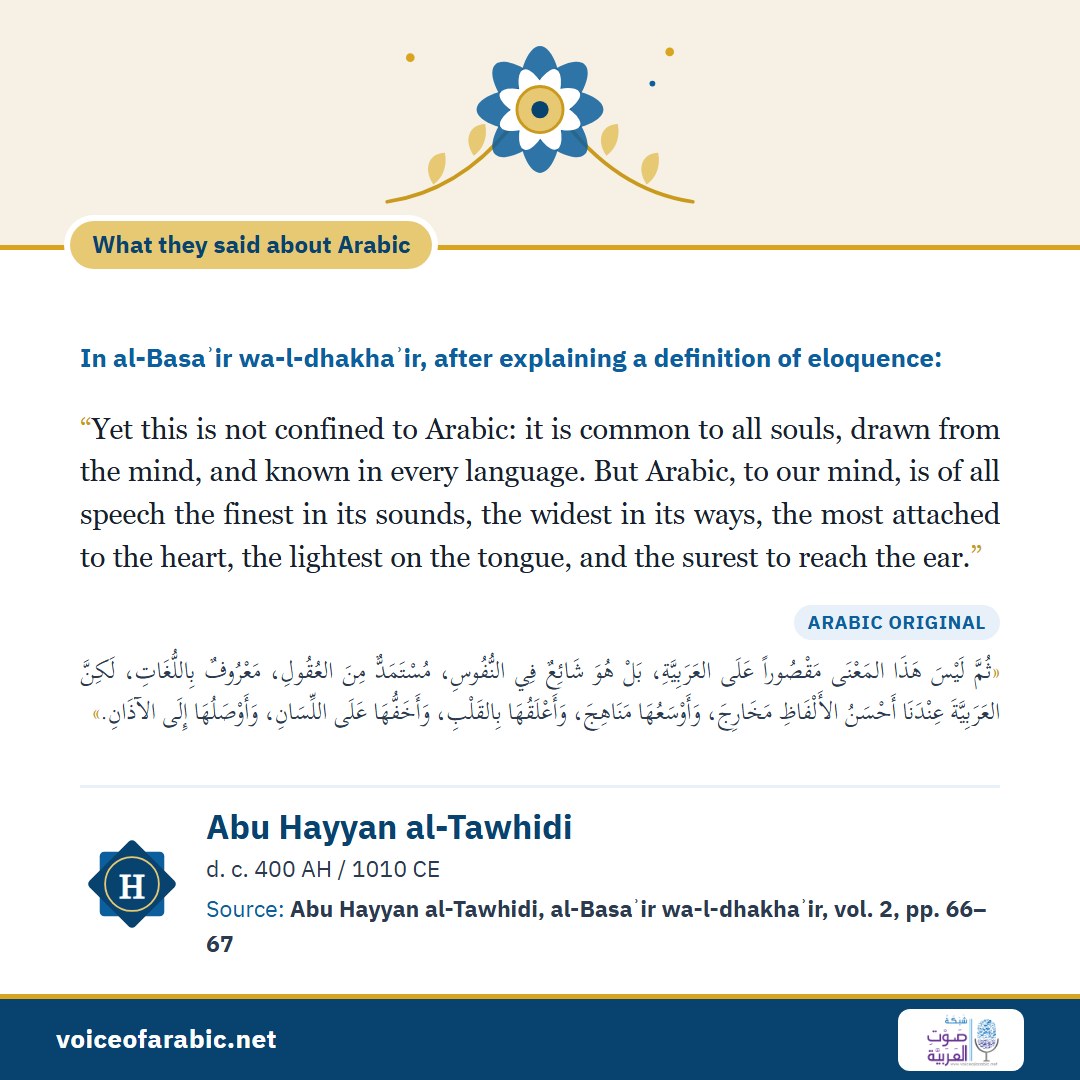
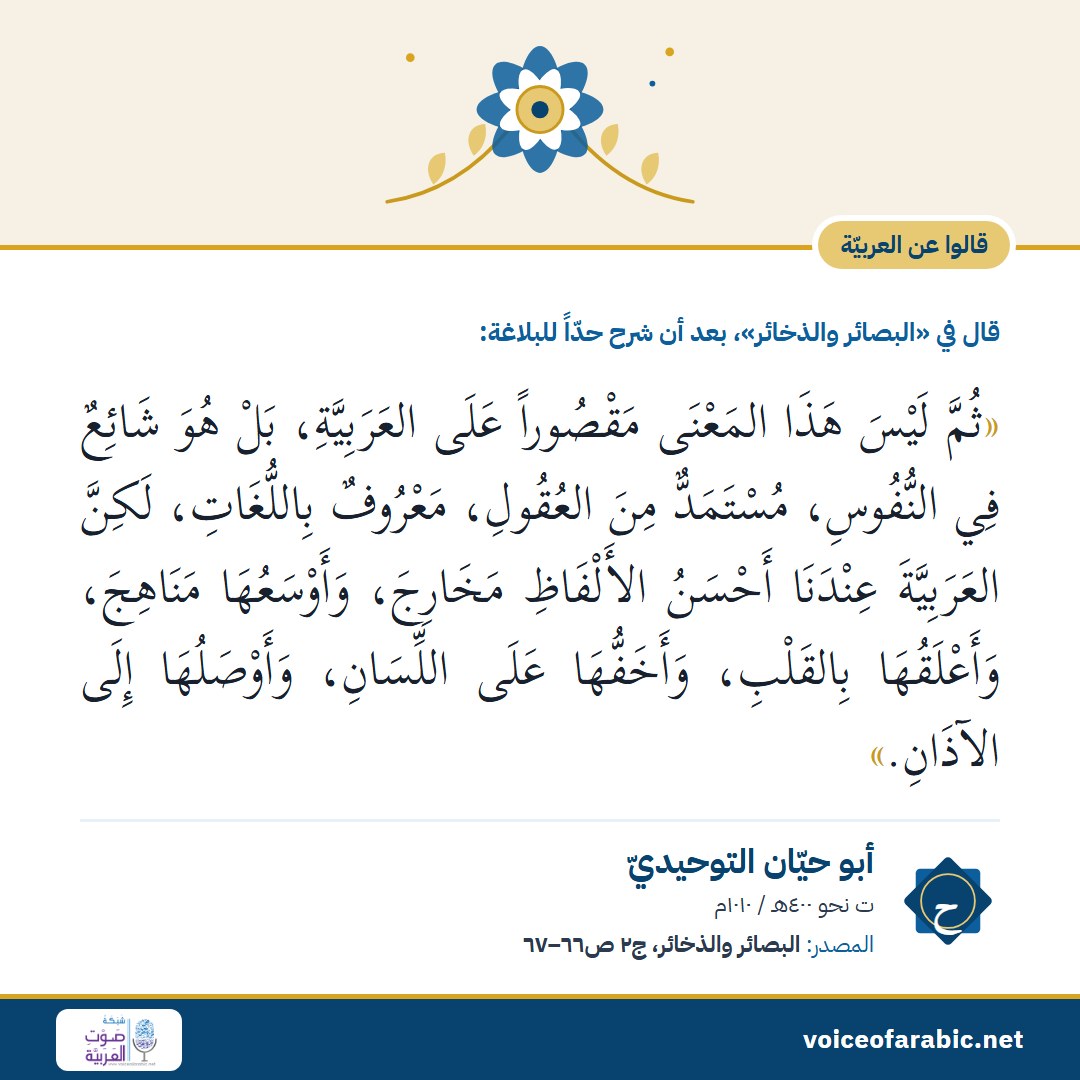
“Yet this is not confined to Arabic: it is common to all souls, drawn from the mind, and known in every language. But Arabic, to our mind, is of all speech the finest in its sounds, the widest in its ways, the most attached to the heart, the lightest on the tongue, and the surest to reach the ear.”
Abu Hayyan al-Tawhidi
d. c. 400 AH / 1010 CE
ʿAli ibn Muhammad ibn al-ʿAbbas, the Baghdad man of letters, “the philosopher among writers and the writer among philosophers”, author of al-Basaʾir wa-l-dhakhaʾir and al-Imtaʿ wa-l-muʾanasa.
The Arabic original
ثُمَّ لَيْسَ هَذَا المَعْنَى مَقْصُوراً عَلَى العَرَبِيَّةِ، بَلْ هُوَ شَائِعٌ فِي النُّفُوسِ، مُسْتَمَدٌّ مِنَ العُقُولِ، مَعْرُوفٌ بِاللُّغَاتِ، لَكِنَّ العَرَبِيَّةَ عِنْدَنَا أَحْسَنُ الأَلْفَاظِ مَخَارِجَ، وَأَوْسَعُهَا مَنَاهِجَ، وَأَعْلَقُهَا بِالقَلْبِ، وَأَخَفُّهَا عَلَى اللِّسَانِ، وَأَوْصَلُهَا إِلَى الآذَانِ.
Source
Abu Hayyan al-Tawhidi, al-Basaʾir wa-l-dhakhaʾir, ed. Wadad al-Qadi, Beirut: Dar Sadir, 1st ed., 1988, vol. 2, pp. 66–67
The English translation is Voice of Arabic's, made from the original.
He first grants that eloquence is found in every nation, then prefers Arabic. The text goes on: “and all these merits follow from the religious law that God made the completion of all laws.”
Tap a card to see it full size; each has a download button below it for sharing.
Spotted a mistake, or have something to add?
Your note comes to us only; it is not published here. We read it, and if it holds we correct the card.