Arabic Words in the Languages of Europe
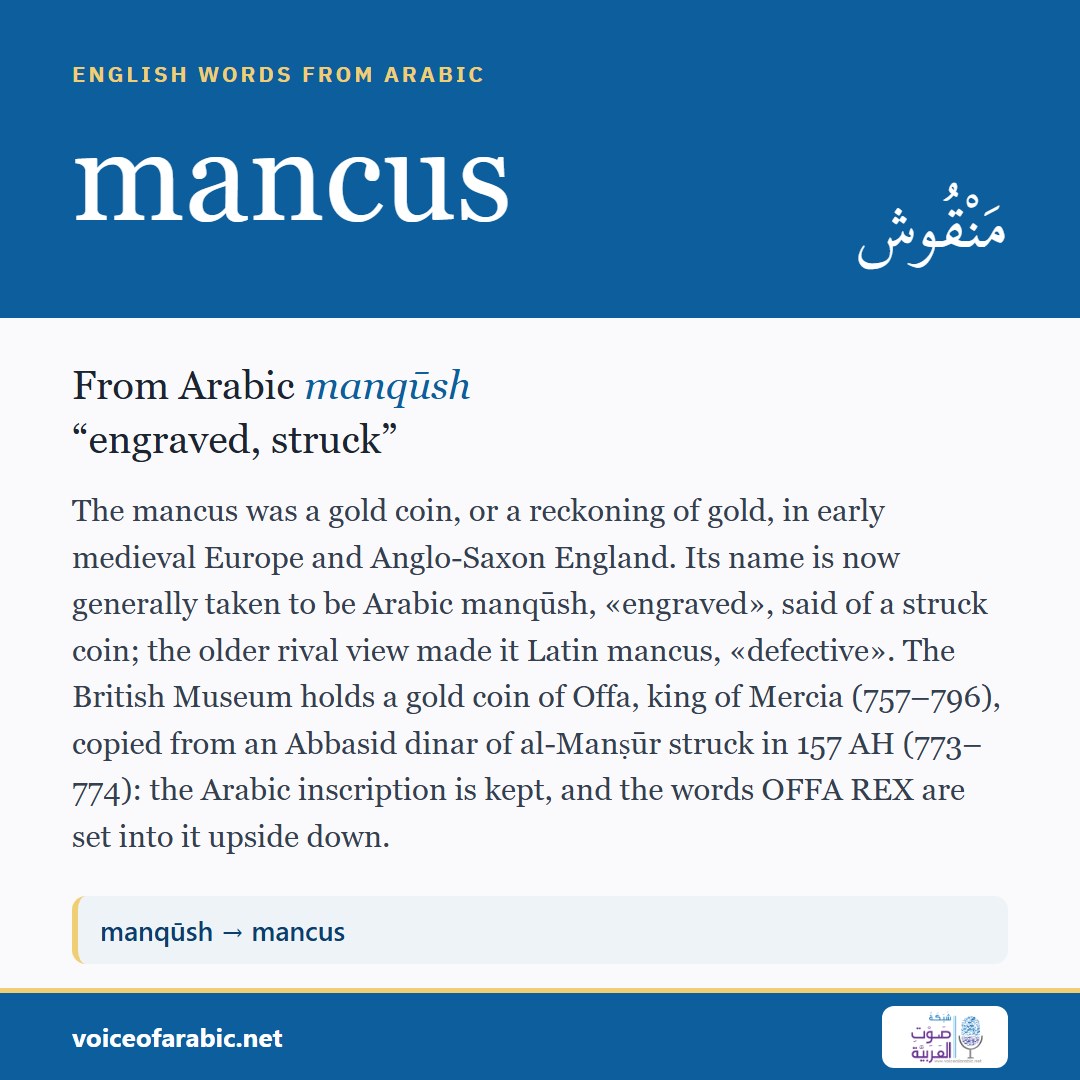
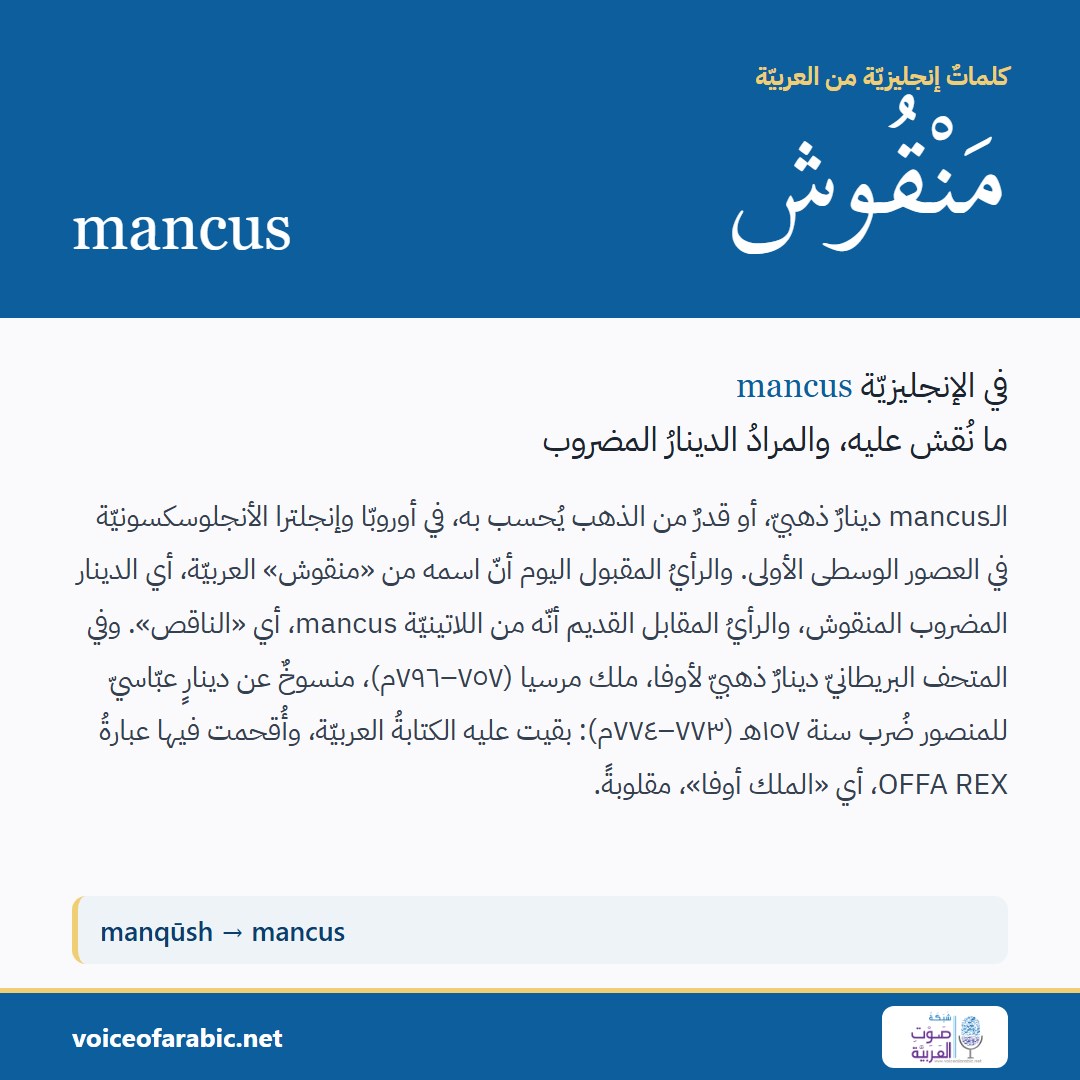
mancus
مَنْقُوش
manqūsh
The mancus was a gold coin, or a reckoning of gold, in early medieval Europe and Anglo-Saxon England. Its name is now generally taken to be Arabic manqūsh, «engraved», said of a struck coin; the older rival view made it Latin mancus, «defective». The British Museum holds a gold coin of Offa, king of Mercia (757–796), copied from an Abbasid dinar of al-Manṣūr struck in 157 AH (773–774): the Arabic inscription is kept, and the words OFFA REX are set into it upside down.
- Language
- English
- Meaning in Arabic
- engraved, struck
- Arabic today says
- مَنْقُوش
The path between languagesmanqūsh → mancus
Click a card to see it full size; each has a download button for sharing.
Sources
- Merriam-Webster: mancus, «Old English, from Medieval Latin mancusus, from Arabic manqūsh engraved»
- British Museum, gold imitation dinar of Offa, reg. no. 1913,1213.1 (Google Arts & Culture): imitates a dinar of al-Mansur «struck in the Islamic year AH 157 (AD 773-74)»; «OFFA REX… inserted upside down»
- Wikipedia: Mancus, citing P. Grierson & M. Blackburn, Medieval European Coinage 1, Cambridge, p. 327, and P. Grierson, «Carolingian Europe and the Arabs: the myth of the mancus», Revue belge de philologie et d'histoire 32 (1954)
Spotted a mistake, or have something to add?
Your note comes to us only; it is not published here. We read it, and if it holds we correct the card.