Arabic Words in the Languages of Europe
al-
أداةُ التعريف «ال»
al-
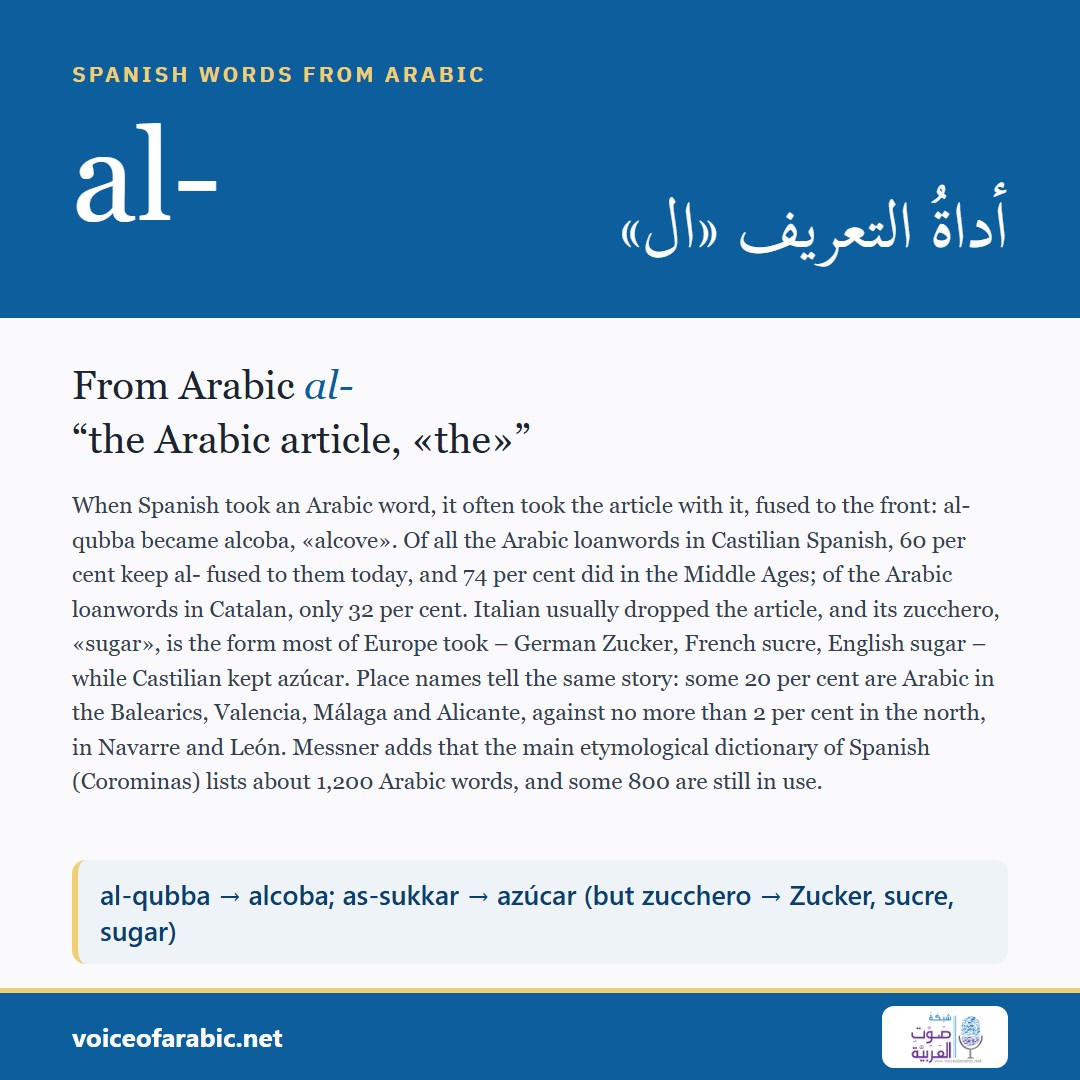
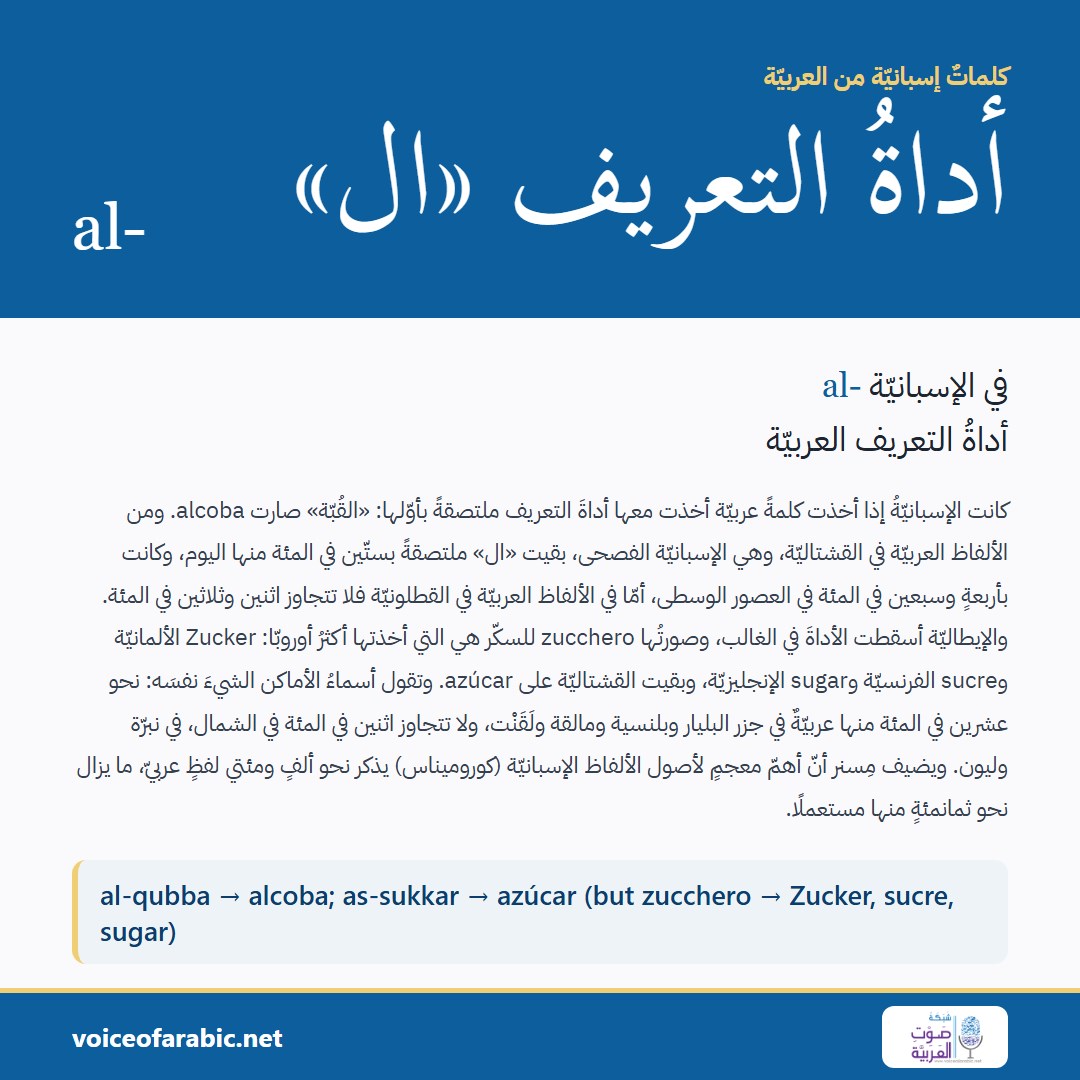
When Spanish took an Arabic word, it often took the article with it, fused to the front: al-qubba became alcoba, «alcove». Of all the Arabic loanwords in Castilian Spanish, 60 per cent keep al- fused to them today, and 74 per cent did in the Middle Ages; of the Arabic loanwords in Catalan, only 32 per cent. Italian usually dropped the article, and its zucchero, «sugar», is the form most of Europe took – German Zucker, French sucre, English sugar – while Castilian kept azúcar. Place names tell the same story: some 20 per cent are Arabic in the Balearics, Valencia, Málaga and Alicante, against no more than 2 per cent in the north, in Navarre and León. Messner adds that the main etymological dictionary of Spanish (Corominas) lists about 1,200 Arabic words, and some 800 are still in use.
- Language
- Spanish
- Meaning in Arabic
- the Arabic article, «the»
Click a card to see it full size; each has a download button for sharing.
Sources
- Real Academia Española, Diccionario de la lengua española: alcoba («Del ár. hisp. alqúbba, este del ár. clás. qubbah…»)
- Real Academia Española, Diccionario de la lengua española: azúcar («Del ár. hisp. assúkkar, este del ár. clás. sukkar…»)
- Dieter Messner, «Further Listings and Categorisations of Arabic Words in Ibero-Romance Languages», in The Legacy of Muslim Spain, Brill 1992, p. 453: «the agglutinated article is present in… 60% of Castilian arabisms today (74% in the Middle Ages), but in only 32% for Catalan»; zucchero and azúcar; Corominas «about 1,200»
- Dieter Messner, ibid., p. 452: «some 20% of toponyms per thousand square kilometres… in the Balearics but also in… Valencia, Malaga and Alicante, are Arabic, whereas such toponyms do not exceed 2% in northern parts like Navarre, Leon»; p. 455: «some 800… still in use»
- Luce López-Baralt, ibid., p. 519: «alcoba: al-qubba»
Spotted a mistake, or have something to add?
Your note comes to us only; it is not published here. We read it, and if it holds we correct the card.