Arabic in the Sciences
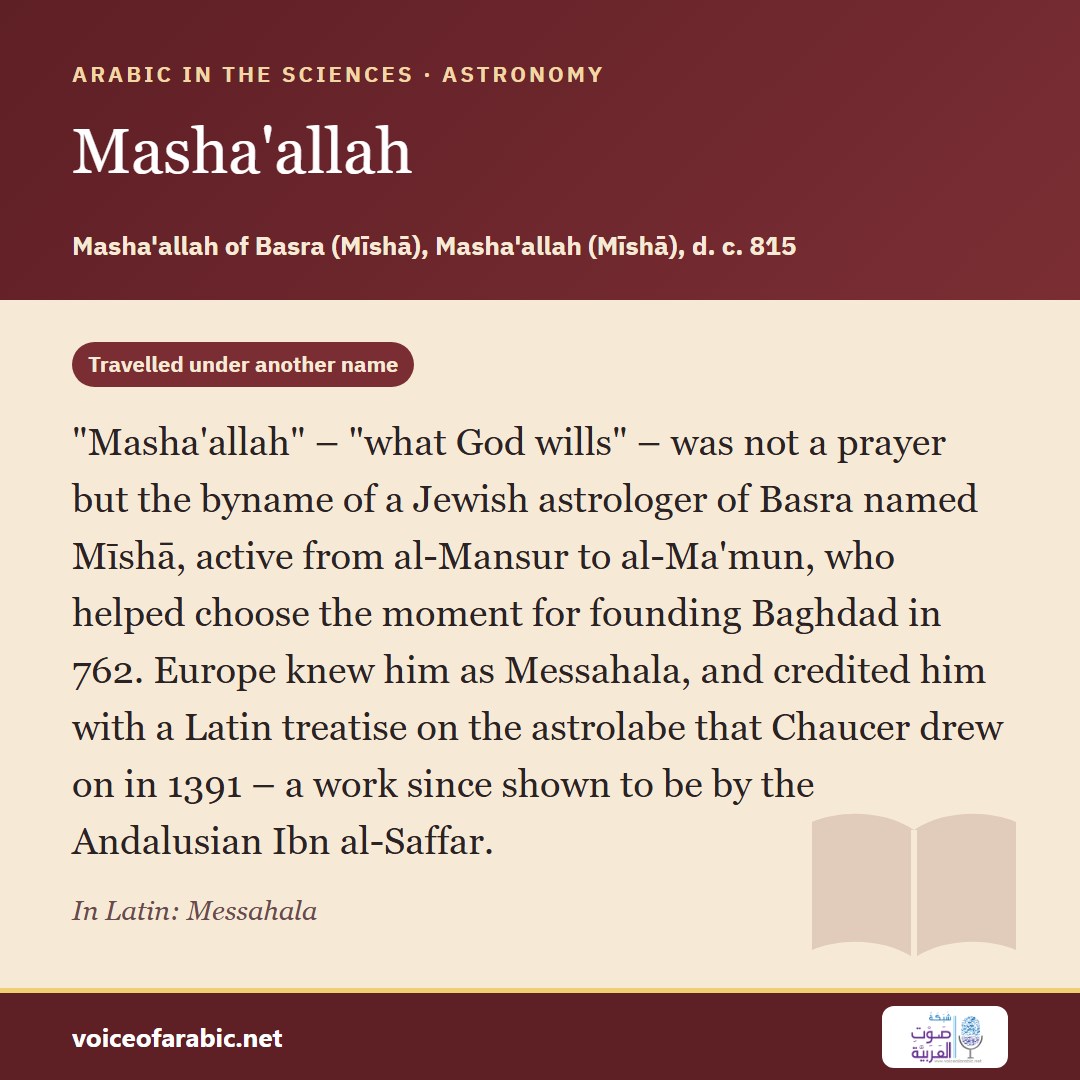
Masha'allah
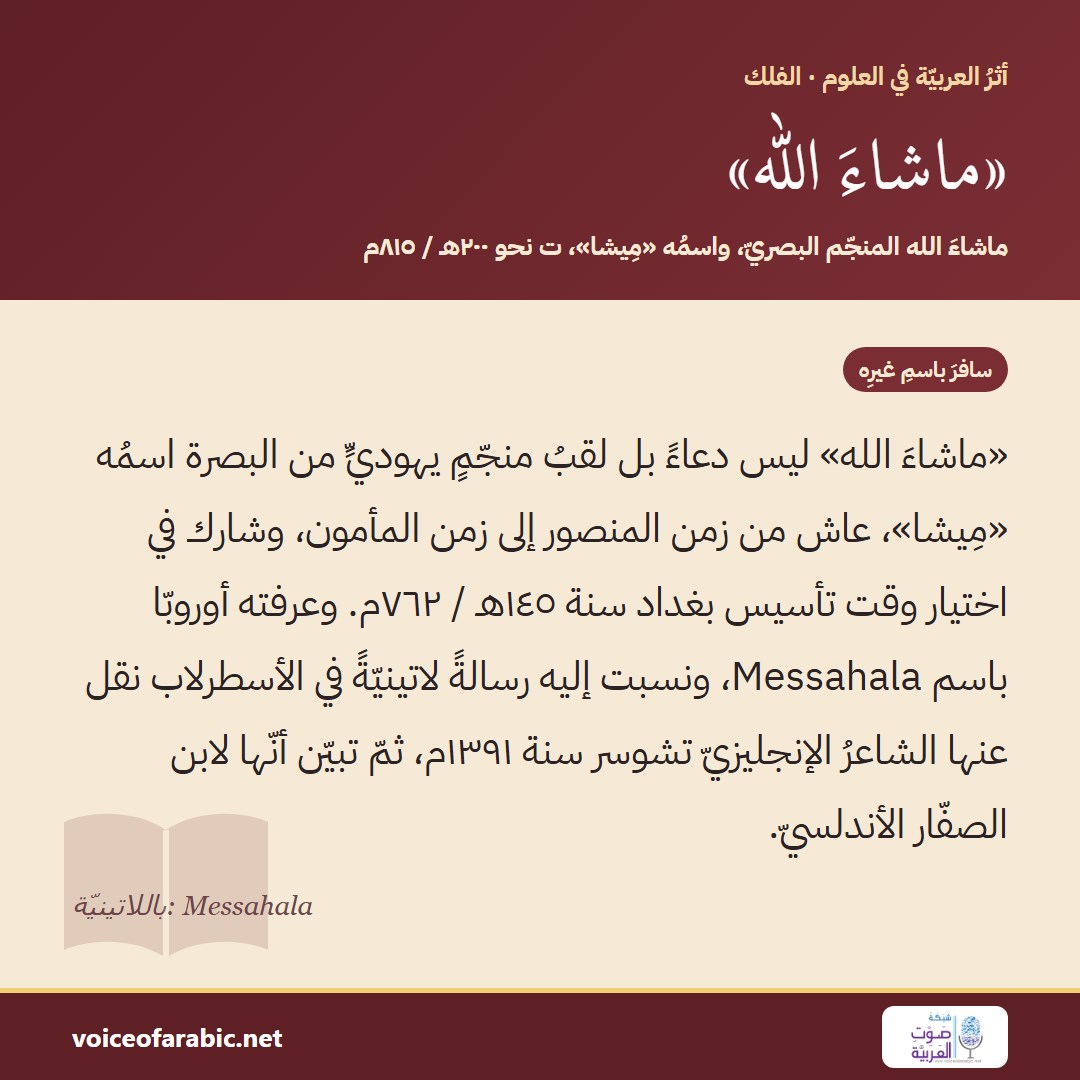
ماشاءَ الله
"Masha'allah" – "what God wills" – was not a prayer but the byname of a Jewish astrologer of Basra named Mīshā, active from al-Mansur to al-Ma'mun, who helped choose the moment for founding Baghdad in 762. Europe knew him as Messahala, and credited him with a Latin treatise on the astrolabe that Chaucer drew on in 1391 – a work since shown to be by the Andalusian Ibn al-Saffar.
- Author
- Masha'allah of Basra (Mīshā) (Masha'allah (Mīshā), d. c. 815)
- Field
- Astronomy
- Arabic title
- رسالةٌ في الأسطرلاب نُسبت إليه، وهي لابن الصفّار الأندلسيّ
- Latin title
- Compositio et operatio astrolabii (Pseudo-Messahala)
An Andalusian work that travelled to Europe under the name of a Basran scholar two centuries older.
A story told of him
It is told that Sufyan al-Thawri met Masha'allah and said: "You fear Saturn and I fear the Lord of Saturn; you hope in Jupiter and I hope in the Lord of Jupiter; you set out after consulting the stars and I set out after praying for guidance – how far apart are we?" Masha'allah answered: "Far apart indeed: your state is more hopeful, your affair more successful and wiser."
Abu Hayyan al-Tawhidi (d. 1023) tells it in al-Muqabasat (p. 123) as a story "the pious relate", and al-Qifti repeats it in Ikhbar al-ulama (p. 244); Ibn al-Qayyim gives it between Abu al-Husayn al-Nuri and "Mania the astrologer".
Click a card to see it full size; each has a download button for sharing.
Sources
- القفطيّ، إخبار العلماء بأخبار الحكماء، تحقيق إبراهيم شمس الدين، دار الكتب العلميّة، ١٤٢٦هـ/٢٠٠٥م، ص ٢٤٤
- أبو حيّان التوحيديّ، المقابسات، ص ١٢٣
- Ari Belenkiy, «Māshāʾallāh ibn Atharī», The Biographical Encyclopedia of Astronomers
- Ron B. Thomson (ed.), Pseudo-Masha'allah, On the Astrolabe (critical edition of the Latin text)
- Wikipedia: A Treatise on the Astrolabe (Chaucer, 1391)
Spotted a mistake, or have something to add?
Your note comes to us only; it is not published here. We read it, and if it holds we correct the card.