Arabic in the Sciences
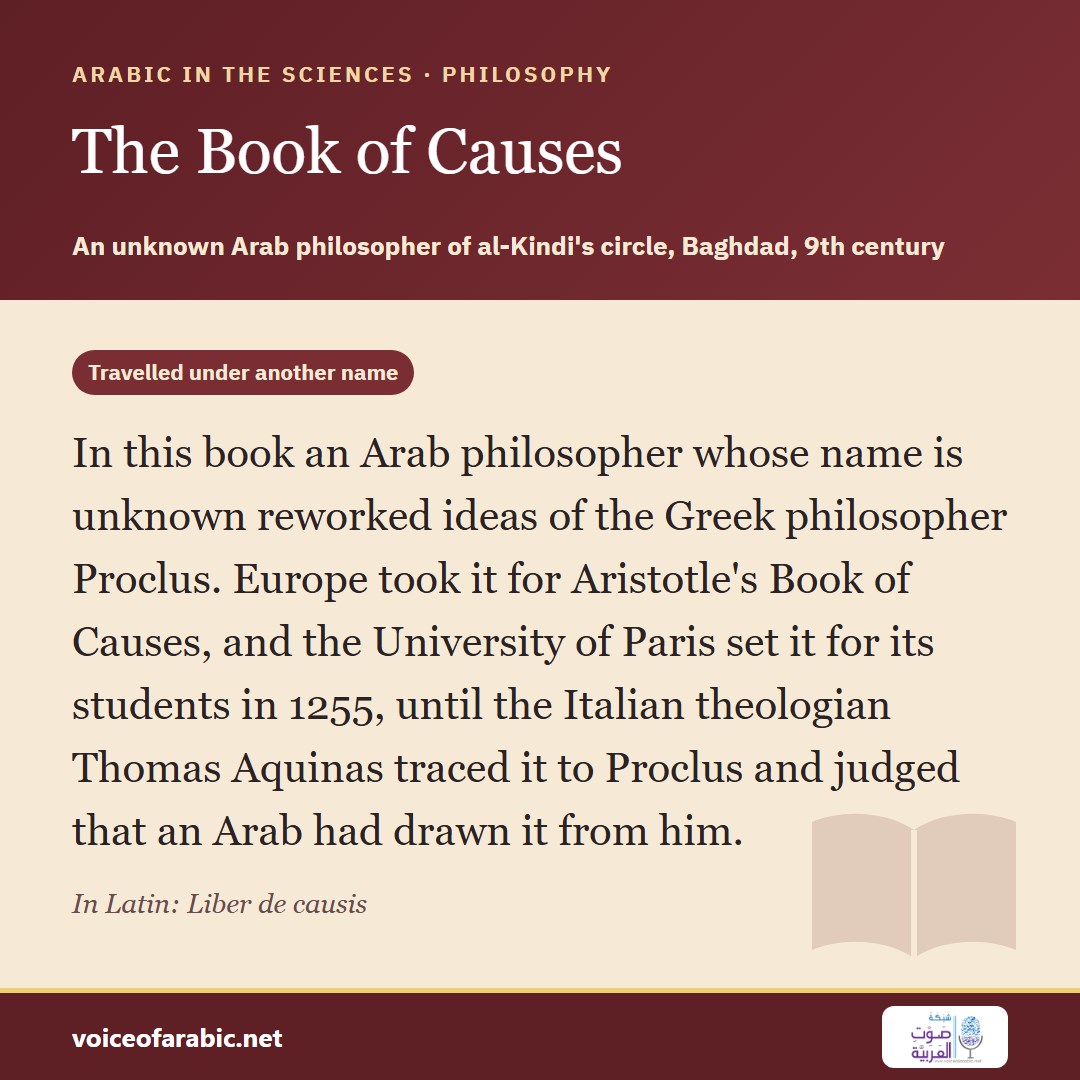
The Book of Causes
الكلام في محض الخير
In this book an Arab philosopher whose name is unknown reworked ideas of the Greek philosopher Proclus. Europe took it for Aristotle's Book of Causes, and the University of Paris set it for its students in 1255, until the Italian theologian Thomas Aquinas traced it to Proclus and judged that an Arab had drawn it from him.
- Author
- An unknown Arab philosopher of al-Kindi's circle, Baghdad (9th century)
- Field
- Philosophy
- Arabic title
- الكلام في محض الخير
- Latin title
- Liber de causis (Liber Aristotelis de expositione bonitatis purae)
Europe knew it under a name not its author's.
Click a card to see it full size; each has a download button for sharing.
Sources
- Dag Nikolaus Hasse, «Influence of Arabic and Islamic Philosophy on the Latin West», Stanford Encyclopedia of Philosophy
- Cristina D'Ancona, «Greek Sources in Arabic and Islamic Philosophy», Stanford Encyclopedia of Philosophy
- Thomas Aquinas, Super librum de causis expositio, prooemium
- D. N. Hasse, «Three Double Translations from Arabic into Latin by Gerard of Cremona», in D. Calma (ed.), Reading Proclus and the Book of Causes, vol. 2 (Brill, 2021)
Spotted a mistake, or have something to add?
Your note comes to us only; it is not published here. We read it, and if it holds we correct the card.