Words Arabic Took In
chartēs
القِرْطاس
qirṭās
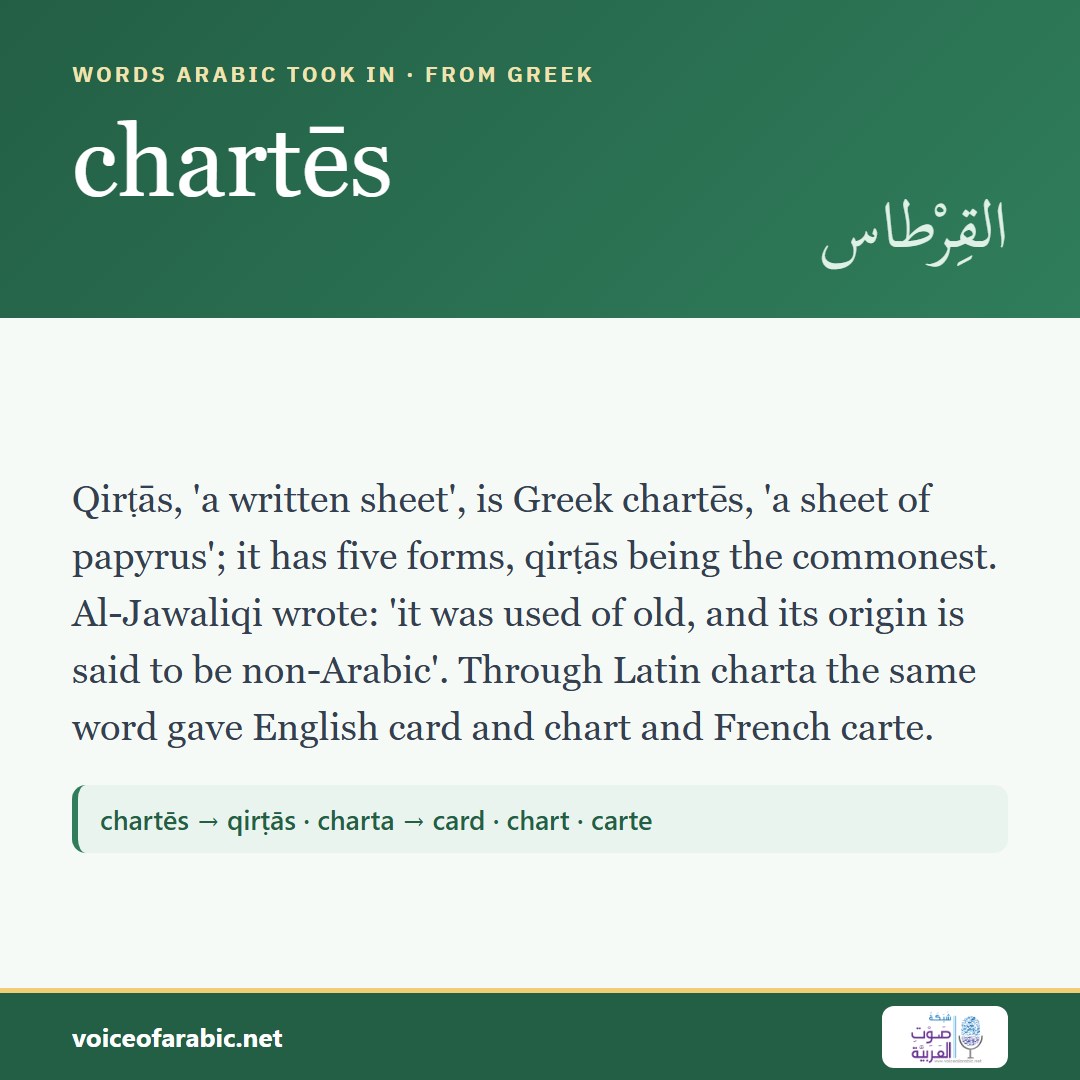
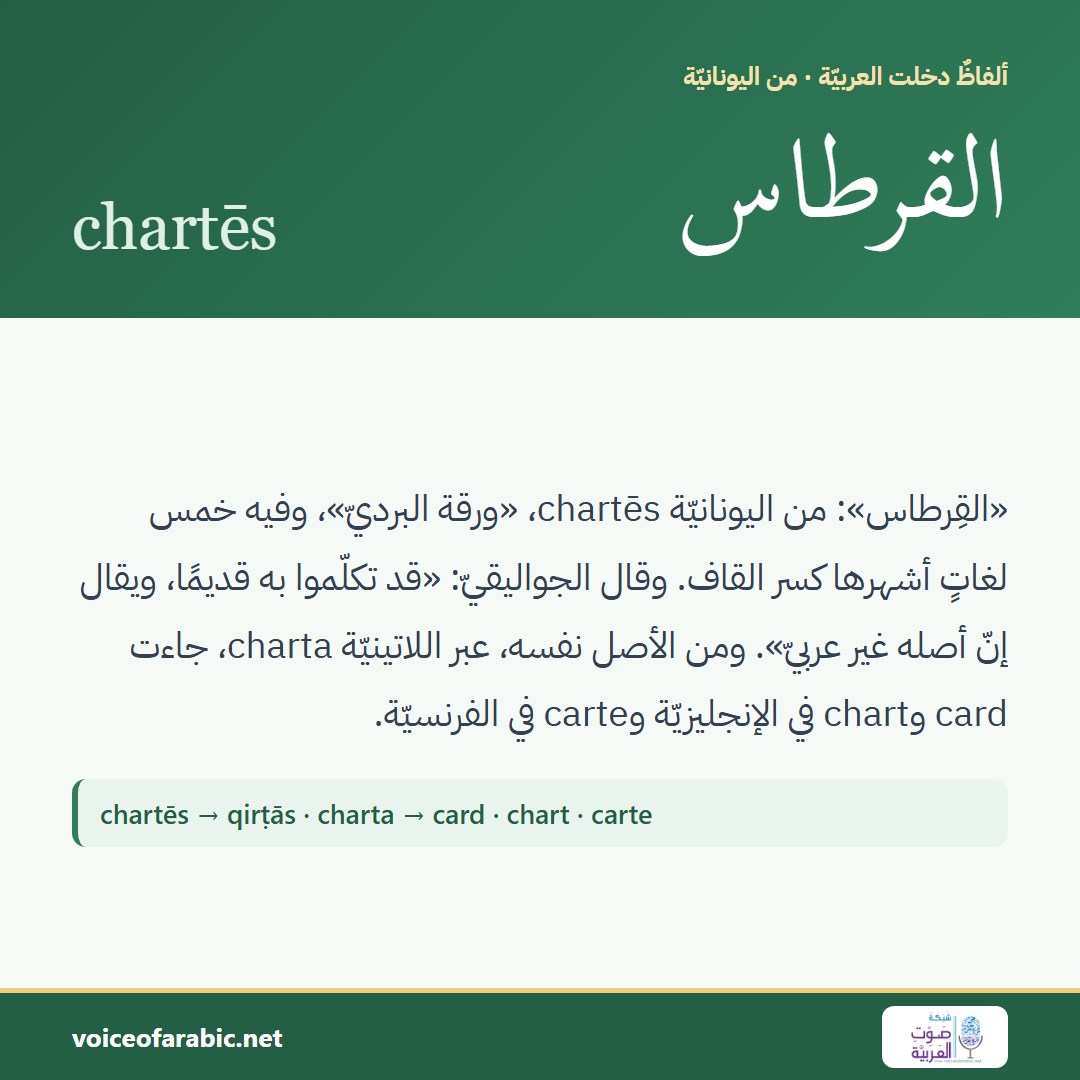
Qirṭās, 'a written sheet', is Greek chartēs, 'a sheet of papyrus'; it has five forms, qirṭās being the commonest. Al-Jawaliqi wrote: 'it was used of old, and its origin is said to be non-Arabic'. Through Latin charta the same word gave English card and chart and French carte.
- Came
- From Greek
- Original meaning
- a sheet of papyrus
- Meaning in Arabic
- a sheet to write on
«قال شيخنا أبو منصور اللغويّ: القرطاس قد تكلّموا به قديمًا، ويقال إنّ أصله غير عربيّ.»
A Qur'anic word. Scholars differed over Qur'anic words said to be of foreign origin: some denied any non-Arabic word in the Qur'an, others accepted them. Abu 'Ubayd al-Qasim ibn Sallam reconciled the two: foreign in origin, Arabised by the Arabs, so Arabic now, and 'both parties are right' (al-Mu'arrab, ed. Shakir, p. 5). Al-Tabari listed qirṭās with dirham, dinar and qalam among words shared by several languages.
F. Abdurrahim (al-Mu'arrab, p. 529) explains its shape: qirṭīs was fitted to the plural pattern fa'ālīl as qarāṭīs, and the singular qirṭās was then made from the plural. Syriac has it with both k and q.
English card and chart and French carte did not pass through Arabic: they come from Latin charta, from Greek chartēs (Wiktionary; TLFi).
Click a card to see it full size; each has a download button for sharing.
Sources
- ابن الجوزيّ، زاد المسير ٢/١١
- الطبريّ، جامع البيان ١/١٥: الدرهم والدينار والدواة والقلم والقرطاس
- الجواليقيّ، المعرّب، تحقيق ف. عبد الرحيم، ص٥٢٩
- Wiktionary: card
- TLFi (CNRTL): carte
Spotted a mistake, or have something to add?
Your note comes to us only; it is not published here. We read it, and if it holds we correct the card.