Arabic Beyond the Arabs
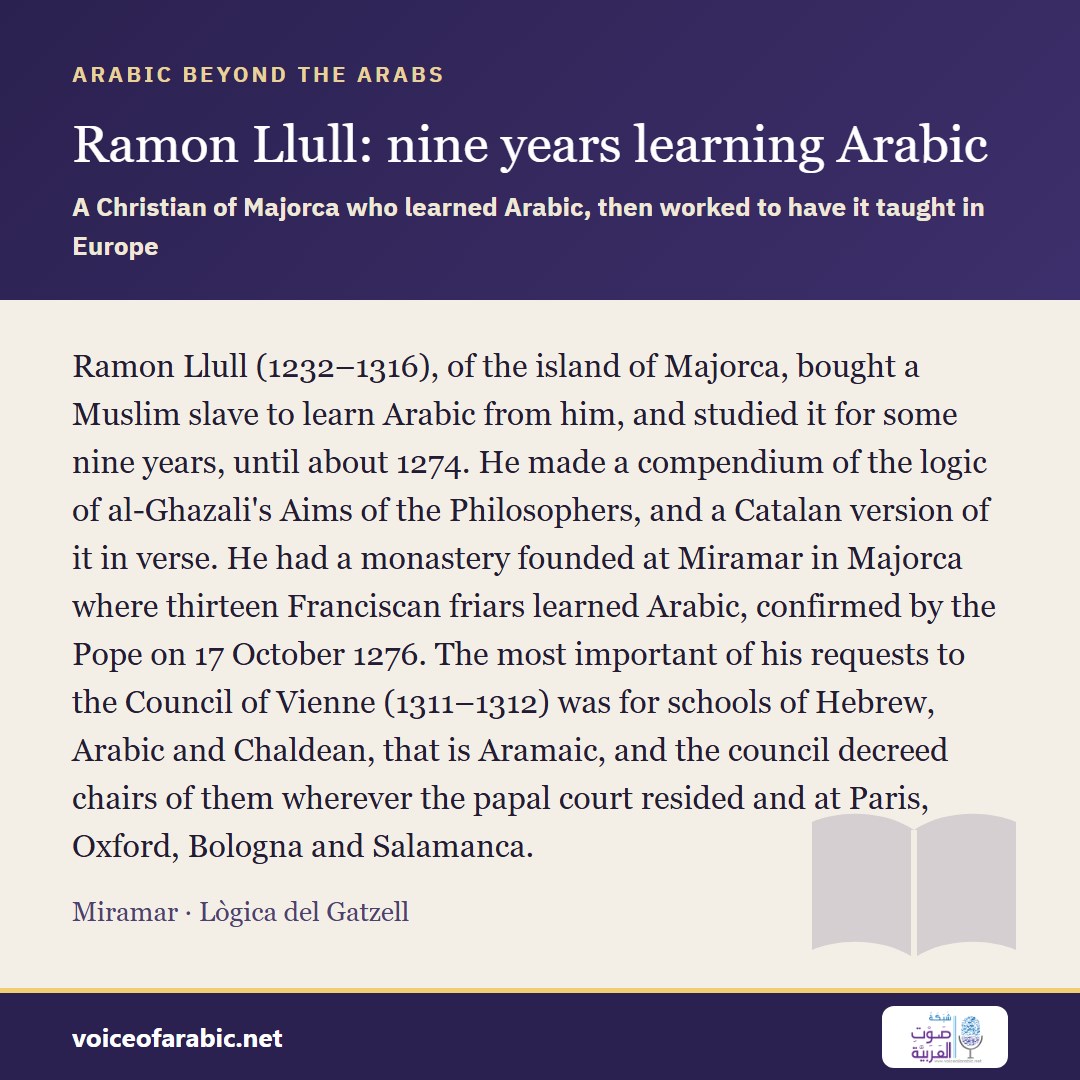
Ramon Llull: nine years learning Arabic
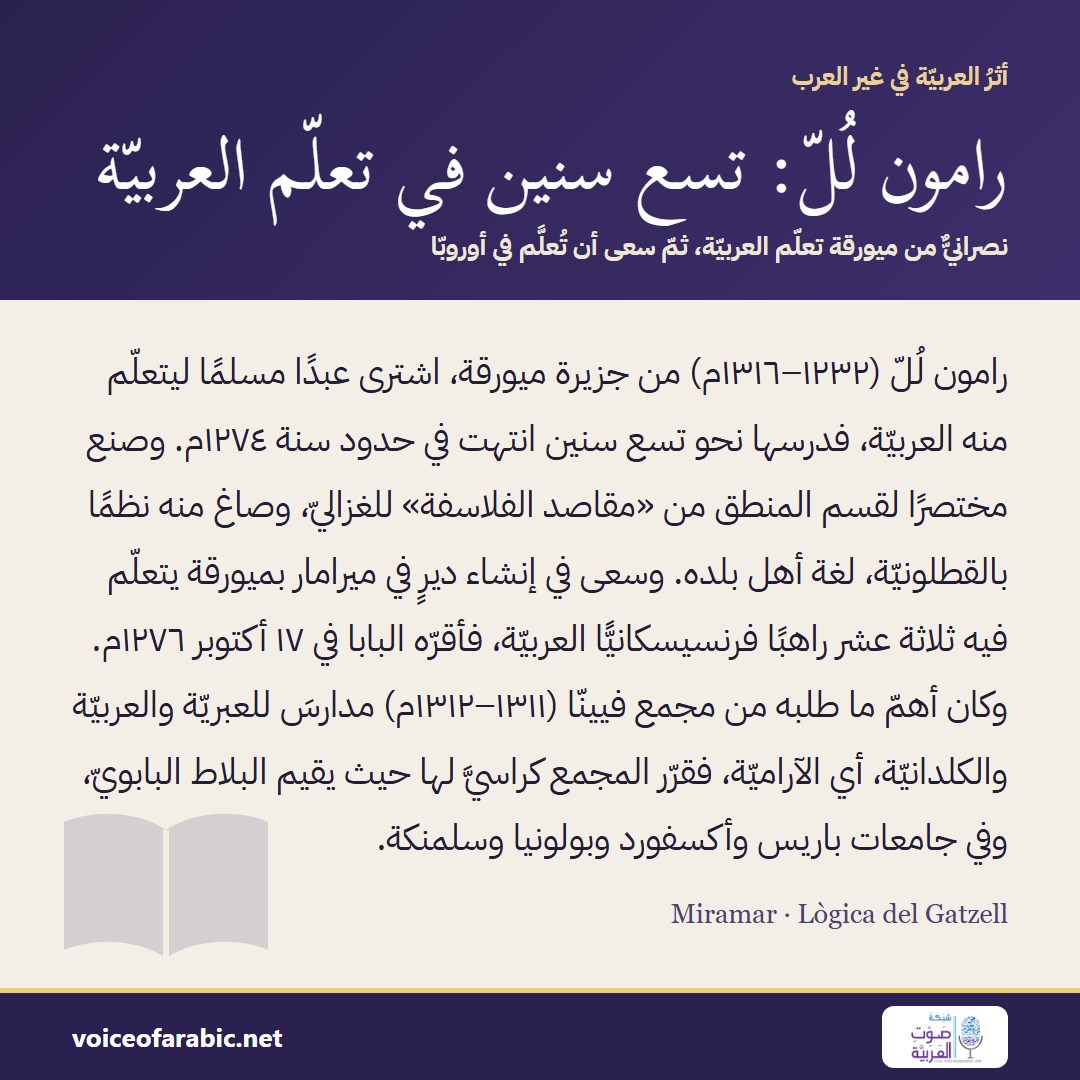
رامون لُلّ: تسع سنين في تعلّم العربيّة
Ramon Llull (1232–1316), of the island of Majorca, bought a Muslim slave to learn Arabic from him, and studied it for some nine years, until about 1274. He made a compendium of the logic of al-Ghazali's Aims of the Philosophers, and a Catalan version of it in verse. He had a monastery founded at Miramar in Majorca where thirteen Franciscan friars learned Arabic, confirmed by the Pope on 17 October 1276. The most important of his requests to the Council of Vienne (1311–1312) was for schools of Hebrew, Arabic and Chaldean, that is Aramaic, and the council decreed chairs of them wherever the papal court resided and at Paris, Oxford, Bologna and Salamanca.
- In brief
- A Christian of Majorca who learned Arabic, then worked to have it taught in Europe
- Outside Arabic
- Miramar · Lògica del Gatzell
«وفي رحلته الأولى هذه إلى مونبلييه اقترح لُلّ على جاقمة الثاني أن يؤسّس ديرًا في ميرامار بميورقة، غايتُه الأولى أن يُعلِّم المبشّرين اللغات، والعربيّةَ خاصّة.»
The Muslim slave and the nine years come from his contemporary Life, the Vita coaetanea (§ 11), not opened in this round; the Stanford Encyclopedia says only that he learned Arabic from a Muslim slave. Llull is said to have written in Arabic, but no Arabic text of his survives, so the card does not claim that the Book of Contemplation was first written in Arabic. He did not translate the whole of the Aims: he made a compendium of its logic (Compendium logicae Algazelis) and a Catalan verse version (Lògica del Gatzell). The Vienne decree is «Inter sollicitudines» in the Clementines (V.1.1); it names «wherever the Roman curia resides», so «Rome» is not simply wrong.
Click a card to see it full size; each has a download button for sharing.
Sources
- Stanford Encyclopedia of Philosophy: Ramon Llull
- Vita coaetanea (سيرة لُلّ المعاصرة، ١٣١١م)، الفقرة ١١؛ وبالإنجليزيّة في A. Bonner (ed.), Selected Works of Ramon Llull, 1985, vol. 1
- مجمع فيينّا (١٣١١–١٣١٢م)، القرار «Inter sollicitudines»، Clementinae V.1.1
Spotted a mistake, or have something to add?
Your note comes to us only; it is not published here. We read it, and if it holds we correct the card.