Arabic in the Sciences
The counters of Gerbert's abacus
خرزاتُ معداد جيربير
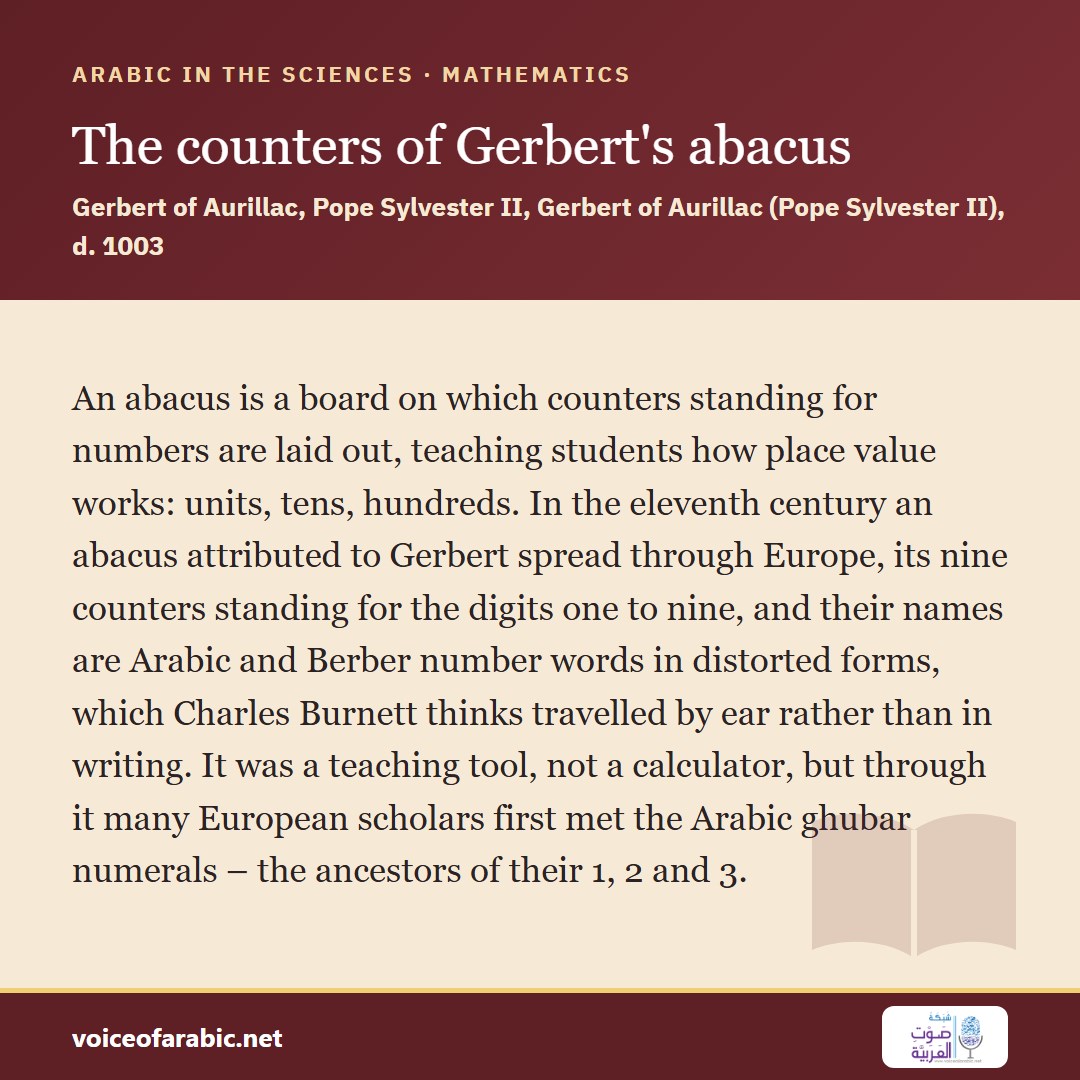
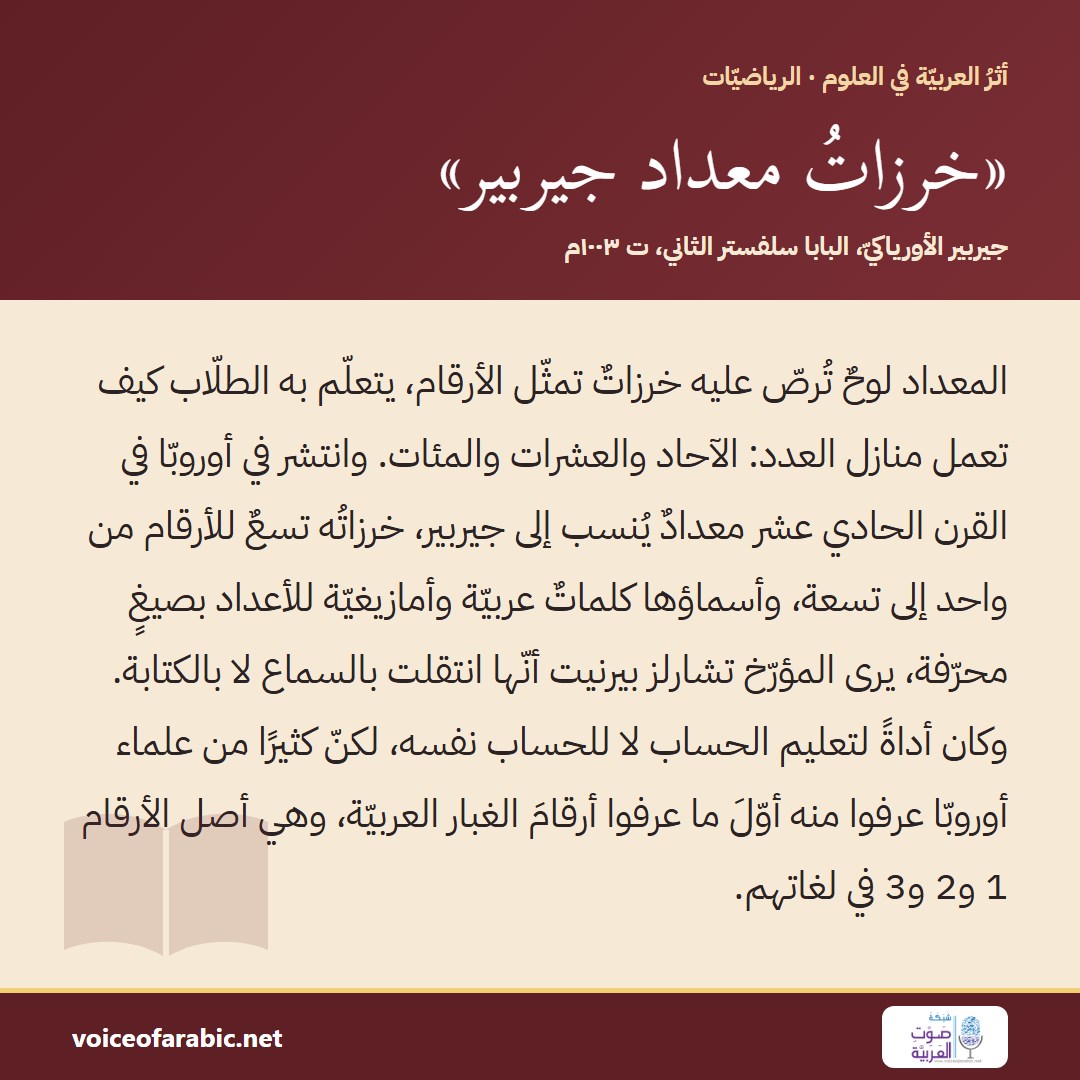
An abacus is a board on which counters standing for numbers are laid out, teaching students how place value works: units, tens, hundreds. In the eleventh century an abacus attributed to Gerbert spread through Europe, its nine counters standing for the digits one to nine, and their names are Arabic and Berber number words in distorted forms, which Charles Burnett thinks travelled by ear rather than in writing. It was a teaching tool, not a calculator, but through it many European scholars first met the Arabic ghubar numerals – the ancestors of their 1, 2 and 3.
- Author
- Gerbert of Aurillac, Pope Sylvester II (Gerbert of Aurillac (Pope Sylvester II), d. 1003)
- Field
- Mathematics
- Arabic title
- أسماء الأرقام على خرزات المعداد
- Latin title
- The Gerbertian abacus and the names of its nine counters
William of Malmesbury
«The first to snatch the abacus from the Saracens and give it rules for use.»
William, abbot of Malmesbury, on Gerbert, quoted in English from Burnett's note; the Latin is in Bubnov's edition of Gerbert's mathematical works (Berlin, 1899, p. 387), not opened here. Burnett says the earliest Latin texts on the abacus do not depend on Arabic texts: what is Arabic in it is the names and the numerals. The card does not say Gerbert studied in Córdoba, which is not established. The ghubar («dust») numerals are named for the dust or sand board they were written on.
Click a card to see it full size; each has a download button for sharing.
Sources
- Charles Burnett, «The Translating Activity in Medieval Spain», in S. K. Jayyusi (ed.), The Legacy of Muslim Spain, Brill 1992, p. 1040 and n. 31
- N. Bubnov, Gerberti Opera Mathematica, Berlin 1899, p. 387
Spotted a mistake, or have something to add?
Your note comes to us only; it is not published here. We read it, and if it holds we correct the card.